

Choosing the right luxury fragrance can be challenging, but it doesn’t have to be. Here’s a quick guide to help you evaluate fragrances effectively:
- Concentration Matters: Higher oil concentrations (like Extrait de Parfum) last longer but stay closer to the skin. Lighter options (like Eau de Parfum) are more casual and project further.
- Ingredient Quality: Look for natural, rare materials and smooth transitions between top, heart, and base notes. High-quality ingredients evolve beautifully over time.
- Sourcing Practices: Ethical brands disclose where their ingredients come from and focus on sustainable production.
- Scent Evolution: A well-crafted fragrance transitions smoothly through its layers, keeping your interest from the initial spray to the dry-down.
- Packaging and Price: Luxury bottles should feel premium and protect the fragrance. Pricing often reflects ingredient rarity and craftsmanship.
- Personal Fit: Test fragrances on your skin to see how they interact with your body chemistry and suit your lifestyle.
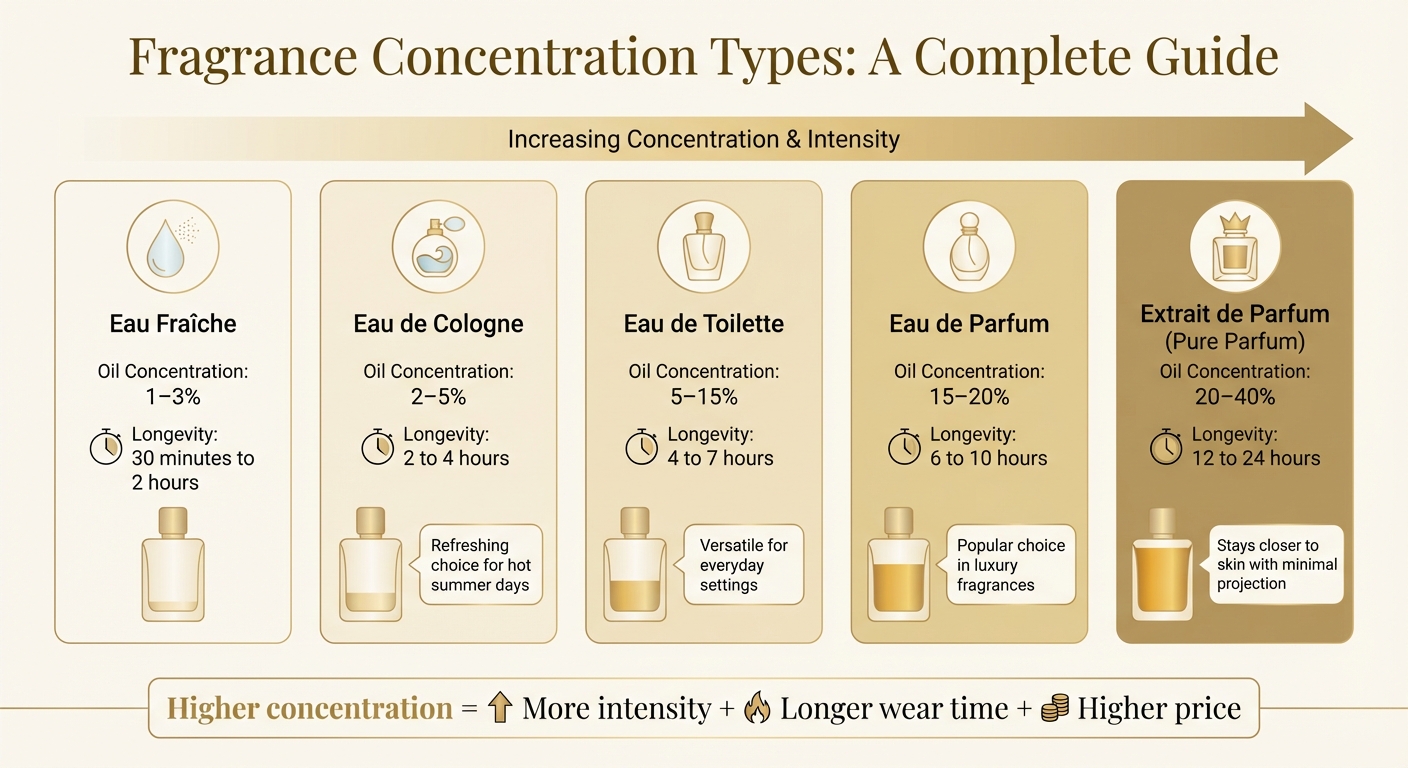
Fragrance Concentration Types: Oil Percentages and Longevity Comparison
Criteria for Rating Fragrance - Factors to Consider when Deciding your Purchase!
1. Concentration and How Long It Lasts
The concentration of a fragrance - essentially the ratio of oil to alcohol and water - plays a key role in how long it lasts and how far its scent travels. Generally, a higher percentage of oil means the fragrance sticks around longer. However, this doesn’t necessarily mean it will fill a room. In fact, the most concentrated fragrances often create a more personal "scent bubble", staying close to your skin rather than projecting widely. Let’s take a closer look at the different concentration types and what they bring to the table.
1.1 Understanding Concentration Types
For something longer-lasting, Eau de Parfum is a popular choice, especially in luxury fragrances. With 15–20% perfume oil, it provides 6 to 10 hours of wear and highlights the heart and base notes, which linger after the top notes fade. At the top of the concentration spectrum is Extrait de Parfum (or Pure Parfum), containing 20–40% oil. This formula can last anywhere from 12 to 24 hours. Because its heavier oil molecules evaporate slowly, it tends to stay closer to the skin, offering longevity without overwhelming projection.
"A higher concentration of perfume oil means more intensity, longer wear time, and often, a higher price." - So Avant Garde
1.2 Testing Duration and Projection
Once you understand a fragrance’s concentration, the next step is to see how it behaves on your skin. Apply it to areas like your outer forearms or inner elbows and give it at least an hour to go through its full cycle - top, heart, and base notes - before forming an opinion.
To gauge projection, pay attention to whether those nearby can detect the scent or if it leaves a subtle trail as you move. For outdoor events, you might need an extra spritz to maintain presence, while in intimate indoor settings, a lighter application is better. Proper storage is also crucial - keep your fragrances in cool, dark places to protect the oils from heat and light, which can degrade their quality over time. And don’t forget: moisturized skin holds onto fragrance molecules longer, so a little prep can go a long way.
2. Ingredient Quality and Sourcing Practices
Once you've evaluated a fragrance's concentration and longevity, it's time to consider the quality and origins of its ingredients. The raw materials used in a fragrance are the foundation of its character, depth, and how well it unfolds over time. High-quality ingredients create a scent that evolves naturally on your skin, while lower-grade materials can result in flat or overly synthetic aromas. To truly understand a fragrance, go beyond the marketing hype and take a closer look at what's inside the bottle, and where those ingredients come from.
2.1 High-Quality and Rare Materials
The best fragrances are built on natural essences that deliver rich, multi-dimensional profiles. For example, sandalwood provides a creamy, woody base; Boronia, a rare flower from Tasmania, contributes honeyed floral tones; and Wattleseed adds a toasty, nutty warmth. These premium ingredients bring complexity and purity to a fragrance, setting it apart from the rest.
When testing a fragrance - whether on a blotter or your skin - you'll notice that high-quality ingredients create clean, evolving scents. Perfumers often evaluate the quality of ingredients by observing how seamlessly the different accords blend and whether the scent maintains its richness from the initial spray to the dry-down.
"We engage with only the most experienced growers, who are passionate about premium crops with full traceability from the field to the final product." - Goldfield & Banks Australia
To identify quality, pay close attention to the fragrance's originality and how it develops over time. Does it surprise you with unique combinations, or does it feel like something you've smelled a hundred times before? Do the notes transition smoothly from top to base, or do they lose momentum after the initial burst? These details can reveal whether a brand has invested in superior, natural ingredients or has leaned heavily on synthetic substitutes.
2.2 Sourcing Transparency and Environmental Responsibility
The origin of a fragrance's ingredients is just as important as their quality. Brands that prioritize transparency often disclose where their materials come from and work directly with growers and distillers. This "field to final product" approach ensures authenticity and ethical harvesting practices.
Look for brands that openly share sourcing specifics, such as the region where their sandalwood is cultivated, how their Boronia is grown, or whether they use environmentally conscious methods. For instance, Goldfield & Banks exemplifies this commitment by partnering directly with Australian growers to source native botanicals like sandalwood, Boronia, and Wattleseed. They also use organic beetroot alcohol as a more sustainable alternative to conventional denatured alcohol, which not only helps preserve the environment but also maintains the integrity of the ingredients.
"Luxury is defined not as extravagance, but the use of the finest essences available without compromising the earth." - Goldfield & Banks Australia
When researching a fragrance, check the brand's website for detailed sourcing information, certifications, or sustainability claims that are backed by evidence. Brands committed to responsible practices will often highlight their partnerships with skilled cultivators and adherence to international standards, such as those set by the International Fragrance Association. If a brand is vague or evasive about where its ingredients come from, it could be a warning sign.
3. Scent Structure and How It Develops
A fragrance's structure tells the story of its journey - from the initial burst when sprayed to the lingering dry-down hours later. This progression is a window into the perfumer's artistry and the quality of the ingredients used. By understanding how a scent evolves, you can better distinguish between a truly luxurious fragrance and one that's simply pleasant at first sniff. Building on earlier discussions about concentration and ingredient quality, this section explores the way a fragrance unfolds over time.
3.1 Note Balance and Progression
Luxury fragrances are often built in three layers: top notes, heart notes, and base notes.
- Top notes: These are the first impression, lasting about 15 to 30 minutes.
- Heart notes: The core of the fragrance, which emerge as the top notes fade, lasting 30 minutes to 2 hours.
- Base notes: The foundation, providing depth and longevity, often lingering for 2 to 8 hours or more.
The magic lies in how these layers blend and transition. A well-crafted fragrance doesn’t abruptly jump from citrus to floral to woody tones. Instead, it flows seamlessly. For instance, as the vibrant top notes fade, the heart notes should ease in naturally, with the base notes gradually grounding the experience. Goldfield & Banks, for example, describes this progression poetically as "Sunrise, Summit, and Sunset" to capture the natural flow of a fragrance's evolution.
When testing a fragrance, apply it to pulse points like your wrists or neck. Avoid rubbing your wrists together - this can disrupt the delicate layering of notes. Pay attention to how the scent develops over time. Check in at intervals like 15 minutes, 1 hour, 2 hours, and beyond. Does the fragrance keep your interest, or does it lose its charm and become flat?
3.2 Character and Complexity
A fragrance's character is what makes it stand out - it’s the unique signature that sets it apart from others. A luxury floral, for example, might surprise you with an unexpected twist, like pairing familiar blooms with an unusual ingredient or reimagining classic notes in a fresh way. Complexity, on the other hand, refers to how the fragrance unfolds over time, revealing new layers rather than remaining static.
Consider whether the fragrance relies on simple, singular notes or intricate accords that interact and evolve. A complex scent might blend creamy Australian Sandalwood with the honeyed sweetness of Boronia and the toasty warmth of Wattleseed, creating a multi-dimensional experience that shifts and deepens as you wear it. Ask yourself: does the fragrance keep surprising you, or does it feel one-dimensional? Does it reveal new facets as time goes on?
Some fragrances are designed to transform dramatically from the initial spray to the dry-down, while others maintain a consistent profile throughout. The key is how well the fragrance achieves its intended design. If it’s meant to change, the transitions should feel cohesive. If it’s meant to stay consistent, it should remain engaging without becoming dull. Originality is important, but it should never come at the cost of wearability - a fragrance can be unique, but if it isn’t enjoyable, it misses the mark.
sbb-itb-a2a0d05
4. Brand Background and Production Methods
Understanding a fragrance’s production methods and the ethos behind a brand can reveal whether you’re investing in genuine artistry or just fancy packaging and clever marketing. By exploring these aspects, we can uncover what truly sets luxury fragrance houses apart from mass-market options.
4.1 Production Techniques and Artistry
The way fragrance materials are extracted and blended plays a huge role in the final scent's quality and depth. Traditional extraction methods help preserve the natural essence of botanicals, while modern techniques deliver precision and consistency. Many high-end brands skillfully combine both approaches. They use time-tested methods alongside cutting-edge tools like Gas Chromatography-Mass Spectrometry (GC-MS), which maps out formulas in detail to ensure accuracy and consistency.
One key factor to look for when assessing a brand's production methods is transparency about concentration levels. High-concentration formulations like Extrait de Parfum or Eau de Parfum signal a dedication to quality. These require premium ingredients and meticulous blending to achieve their complexity. True artisans also design fragrances that evolve over time, revealing distinct top, middle, and base notes, rather than staying flat or one-dimensional. Goldfield & Banks exemplifies this balance of tradition and innovation, weaving their heritage into every stage of production.
4.2 About Goldfield & Banks
Goldfield & Banks is a brand that embodies craftsmanship and innovation. Founded in 2016 by Belgian–French entrepreneur Dimitri Weber, the house set out to create something unique: a luxury perfume line dedicated to Australian ingredients, paired with French perfumery expertise. After relocating to Sydney, Weber partnered with local growers and distillers to spotlight native Australian botanicals like Sandalwood, Boronia, and Wattleseed, ingredients rarely seen in the global perfume scene.
The production process at Goldfield & Banks reflects an unwavering commitment to quality. Native Australian botanicals are harvested and processed locally to produce pure, high-grade oils. These are then blended with international essences before being sent to France for the final touch: blending with organic alcohol using traditional French techniques. This thoughtful process ensures the integrity of rare Australian ingredients while incorporating refined French artistry. The brand also emphasizes full traceability, ensuring every step, from field to final product, meets their high standards.
"We engage with only the most experienced growers, who are passionate about premium crops with full traceability from the field to the final product." - Goldfield & Banks Australia
Since its launch, Goldfield & Banks has gained international recognition for its distinctive approach. By blending native Australian botanicals with French craftsmanship, they craft fragrances that tell stories rooted in specific locations. Today, the brand remains independent, celebrated for its dedication to sustainability, artistry, and discovery. Their offerings range from discovery sets (10 x 2ml samples) to full-size bottles, along with guides for layering perfumes. This meticulous production process provides a valuable benchmark for evaluating a fragrance’s artistry and quality.
5. Packaging and Price Considerations
When it comes to luxury fragrances, the packaging and pricing are as much a part of the experience as the scent itself. The design of the bottle should exude sophistication and craftsmanship, while the price should reflect the rarity of the ingredients and the lasting quality of the fragrance. Let’s dive into how these two elements play a role in defining a luxury fragrance.
5.1 Bottle Design and Visual Quality
Once a fragrance's formulation and sourcing are perfected, the packaging is the finishing touch that signals its luxury status. A high-end fragrance bottle isn’t just about looks - it’s about the feel, too. A well-made bottle often has a satisfying weight, crafted from high-quality glass with crystal-clear clarity. Details like refined caps and precise finishes further underscore its premium nature. But it’s not just about materials; the packaging should also tell a story, connecting visually to the fragrance’s inspiration.
Take Goldfield & Banks, for example. In early 2025, the brand launched its "Coast to Coast" campaign, collaborating with Australian artist Felix Nankivell. The bottles were transformed into "sun-drenched art", featuring original paintings that captured the essence of coastal breezes and landscapes. This kind of storytelling elevates the packaging from functional to artistic.
Functionality matters, too. Packaging that combines elegance with practicality - like deluxe coffrets - stands out. These often include a full-size bottle paired with smaller travel options, ensuring convenience without sacrificing style. The 2026 Ingenious Ginger Deluxe Coffret is a perfect example, blending thoughtful design with the vibrant energy of tropical Australia. Beyond aesthetics, quality packaging also serves a protective role, shielding the fragrance’s delicate oils from light and temperature changes that could compromise its integrity.
5.2 Evaluating Price and Value
Price is another key indicator of a fragrance’s quality, often tied to the rarity of its ingredients and the craftsmanship behind its formulation. Luxury fragrances command higher prices because they rely on rare, natural materials rather than cheaper synthetic alternatives.
The concentration of oils in a fragrance also impacts its price. Parfum or Extrait concentrations (15–40% oil) offer long-lasting wear - up to 12 hours or more - compared to the 4–7 hours typical of Eau de Toilette. This longevity justifies their higher cost. Transparency in pricing is another hallmark of quality. Brands that openly share details - like sourcing bergamot from Calabria or using native Australian botanicals with full traceability - demonstrate confidence in their products.
Goldfield & Banks provides a good example of tiered pricing. Their Discovery Sets, featuring 10 x 2 ml samples, start at $90 AUD, while individual fragrances begin at $54 AUD for smaller sizes. Additionally, the brand’s commitment to sustainability adds further value to their pricing, aligning with modern consumer priorities.
6. Personal Fit and Practical Use
Even the priciest fragrance won’t feel indulgent if it doesn’t complement your body chemistry or align with your lifestyle. The last step in finding the perfect luxury scent is seeing how it interacts with your skin and whether it fits the occasions you envision. This is where theory meets reality - where you truly determine if a fragrance is worth the investment.
6.1 Testing on Your Skin
A scent that smells fantastic on a paper blotter can change dramatically when it meets your skin. Your unique body chemistry plays a big role in how a fragrance develops and how long it lasts. Many niche fragrances are designed to adapt to your chemistry, creating a personalized scent experience rather than a generic aroma.
Start by testing on a blotter to get a sense of the top notes, but don’t stop there. Apply the fragrance to pulse points like your wrists, neck, or behind your ears, where body heat helps the scent meld with your skin. Avoid rubbing your wrists together, as this can alter the scent’s composition.
The real test happens over time. Top notes fade within 5 to 15 minutes, so it’s crucial to wait at least an hour to experience how the heart and base notes evolve. As Coco Chanel famously said, "Where should one use perfume? Wherever one wants to be kissed". Before committing, make sure the drydown phase - the scent’s final and longest-lasting stage - truly resonates with you. Keep in mind that oily skin tends to hold fragrances longer, while dry skin might require a richer concentration or even a layer of scent-free moisturizer to help the fragrance last.
Once you’ve figured out how a fragrance interacts with your skin, it’s time to think about how it fits into different settings.
6.2 Choosing for Different Occasions
Not all luxury fragrances are created for the same purpose. A scent that works perfectly for a casual day out might not be the best choice for a formal evening event. Understanding how different fragrance families suit various occasions can help you curate a collection that’s as versatile as your wardrobe.
Fresh or aquatic scents are perfect for daytime and casual wear, especially in warmer weather. Think of the breezy, coastal vibe of something like Pacific Rock Moss. On the other hand, woody or amber fragrances bring depth and elegance, making them ideal for formal events, evenings, or cooler seasons. Notes like sandalwood or leather can leave a memorable impression in both professional and intimate settings.
Adjust your fragrance application based on the occasion. For everyday wear, around seven sprays might be just right. For outdoor events or lighter scents, you may need up to a dozen sprays to ensure the fragrance lingers. If you’re attending a formal gathering and want to create a subtle yet noticeable "scent trail", try applying the fragrance to your shoulders instead of just your wrists. You can also experiment with layering - a lighter scent first, followed by a deeper one - to craft a unique signature without overwhelming the room.
If you’re unsure, discovery sets can be a great way to test how a fragrance evolves throughout the day, helping you find the perfect match for every occasion.
Conclusion
When it comes to choosing a luxury fragrance, every detail plays a role in shaping the experience. From the concentration that affects how long the scent lingers, to the quality of ingredients that reflect the artistry behind the creation, and even how the fragrance evolves from top to base notes - each aspect contributes to the overall allure. Selecting a fragrance is more than just picking a scent; it’s about embracing its journey, understanding its ethical origins, and ensuring it complements your lifestyle in a meaningful way.
Goldfield & Banks Australia exemplifies this thoughtful approach to luxury perfumery. The brand stands out for its dedication to transparency and responsible ingredient sourcing. As they put it:
"To us, luxury is defined not as extravagance, but the use of the finest essences available without compromising the earth".
This vision is reflected in every step of their process, from collaborating directly with Australian growers to maintaining full traceability and committing to sustainable practices throughout production.
For those eager to embark on their fragrance journey, discovery sets provide an excellent opportunity to explore a range of scents before committing to a full-sized bottle. A luxury fragrance isn’t just an accessory - it’s a way to express your individuality and tell your unique story.
FAQs
How do I choose the right fragrance concentration for my lifestyle?
To choose the right fragrance concentration, think about your daily routine and the occasions where you'll wear it. The concentration of a fragrance directly affects its strength and how long it lingers. For instance, Parfum, with 20–30% fragrance oil, can last 8–12 hours, while lighter options like EDT (5–10%) typically last 3–5 hours. Testing the fragrance on your skin is key - it interacts with your body chemistry and environment, which can alter its scent. If it feels overpowering or fades too quickly, try a different concentration that aligns better with your preferences.
Cost and size are also worth considering. While higher concentrations tend to cost more upfront, they require fewer sprays, often making them a smarter investment over time. By weighing these factors, you can find a fragrance that not only suits your lifestyle but also feels just right for you.
How can I tell if a fragrance's ingredients are ethically sourced?
To make sure a fragrance is sourced responsibly, start by looking into its traceability. Trustworthy brands should clearly outline where their ingredients come from and confirm that they’re gathered in a responsible way. This level of transparency helps ensure that farmers are paid fairly and that local environments are treated with care.
Next, pay attention to sustainability. Seek out brands that emphasize the use of native, responsibly harvested plants and adopt eco-conscious farming techniques. Protecting biodiversity and reducing harm to nature are strong signs of ethical sourcing.
Finally, think about the well-being of the communities involved in creating the fragrance. Ethical practices include fair pay, safe working conditions, and initiatives that support local economies. By considering these factors, you can feel good about the story behind the scent you choose.
How can I tell if a fragrance works well with my skin chemistry?
To determine if a fragrance works well with your skin chemistry, apply it directly to pulse points like your wrists, inner elbows, or behind your ears. Let the scent develop over several hours. Fragrances go through different stages: top notes appear first, followed by heart notes, and finally base notes, which mix with your skin’s natural oils. If the scent feels pleasant and balanced as it settles, it’s likely a good fit. On the other hand, if it turns sharp, overly sweet, or flat, it might not complement your chemistry.
For a more in-depth test, consider using a sample set to try out several fragrances over time. Apply each one on clean skin and observe how it evolves in different situations, such as after exercise or in varying weather conditions. This method allows you to see how each scent holds up and ensures you choose one that feels consistent and enjoyable in all scenarios.
You can also try layering fragrances by combining a lighter scent with a richer one. If the blend feels harmonious and enhances the original fragrance, it’s a good sign that the perfume works well with your skin. Sampling, testing in different conditions, and experimenting with layering are all great ways to find your ideal luxury fragrance.